Disclosure: As an Amazon Associate, Body Part Archive earns from qualifying purchases. This means if you click on a link and buy something, we may earn a small commission at no extra cost to you.
Introduction: The Organ You Live Inside
When we think of vital organs, we usually picture the brain, heart, or liver. However, the largest and arguably most heavily assaulted organ in the human body is the one you are looking at right now: your skin.
The Integumentary System is a masterclass in biological engineering. It is not just a static wrapper; it is a highly dynamic, self-healing armor. Through a continuous process called “Epidermal Turnover,” your skin completely replaces its outer barrier roughly every 28 days. Let’s open the archives and look under the microscope to see how stem cells, pigment producers, and lipids work together to keep you alive.
The Journey Upwards: The Layers of the Epidermis
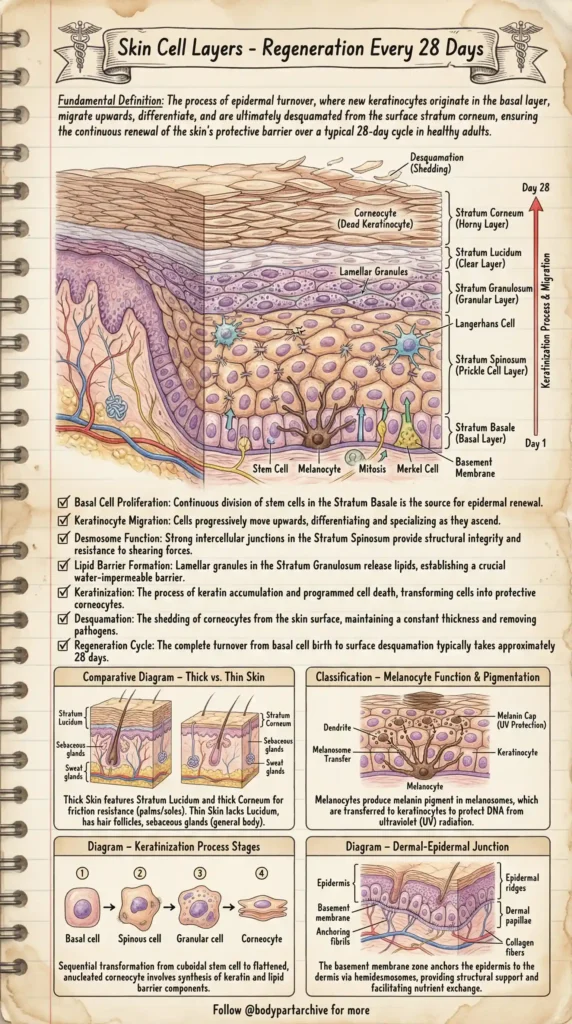
The epidermis (the outermost layer of your skin) is built like a brick wall, but the bricks are constantly moving. The journey of a skin cell (Keratinocyte) starts at the very bottom and ends at the surface:
Stratum Basale (Basal Layer): This is the nursery. Resting on the basement membrane, stem cells here are in a constant state of mitosis (division), pushing older cells upwards.
Stratum Spinosum (Prickle Cell Layer): As cells move up, they form strong intercellular junctions (Desmosomes). This gives your skin its structural integrity and resistance to shearing forces.
Stratum Granulosum (Granular Layer): Here, the cells begin to release lamellar granules, which are essentially lipids (fats). This forms the crucial water-impermeable barrier that stops you from dehydrating.
Stratum Lucidum (Clear Layer): Found only in thick skin (like the palms of your hands and soles of your feet), this extra layer provides intense friction resistance. Notice how thick skin lacks hair follicles and sebaceous glands!.
Stratum Corneum (Horny Layer): The final destination. The cells are now dead, flattened “Corneocytes” packed tightly with keratin. Eventually, they undergo desquamation—shedding off into the environment to remove attached pathogens.
Netter’s Histology Flash Cards: A Companion to Netter’s Essential

Custom Text: “Mastering the microscopic layers of the human body can be tough. We highly recommend adding a premium Histology guide to your study desk to visualize cellular structures like the Dermal-Epidermal junction perfectly.”
The Secret of the Tan: Melanocytes
Nestled down in the Stratum Basale are specialized, spider-like cells called Melanocytes. Their job is critical: protecting your DNA from the sun’s ultraviolet (UV) radiation.
When UV rays hit your skin, melanocytes kick into overdrive, producing a dark pigment called Melanin. Using their long dendrites, they physically transfer these melanin packets (Melanosomes) into the surrounding keratinocytes. The keratinocytes then arrange this pigment like a tiny biological umbrella over their nucleus, shielding the delicate DNA inside from radiation. A “tan” is actually your skin’s visible defense mechanism actively trying to prevent cellular mutation!
The Keratinization Process: A Programmed Death
The entire 28-day cycle relies on a brutal but necessary process called Keratinization.
Looking at the comparative stages, a cell starts as a plump, living cuboidal stem cell. As it is pushed upwards away from the blood supply of the dermis, it slowly starves. It begins synthesizing massive amounts of a tough protein called Keratin. By the time it reaches the top, the nucleus has dissolved, and it has transformed into a flattened, dead, microscopic shield.
Conclusion
Every time you wash your hands, scratch your arm, or dry off with a towel, you are shedding thousands of dead corneocytes. The 28-day skin cycle is a beautiful, continuous loop of birth, specialization, defense, and sacrifice, all designed to keep the chaos of the outside world from getting in.