Introduction: The Illusion of Uniformity
When you look at a bicep or a quadricep, it appears to be a single, solid piece of tissue. However, dive beneath the fascia and examine the muscle under a microscope, and you’ll find a highly diverse biological engine.
Skeletal muscles are actually a mosaic of different “fiber types,” each genetically and metabolically engineered for vastly different tasks. From maintaining your posture for 16 hours a day to helping you sprint away from danger, your body relies on the delicate balance between Slow Twitch (Type I) and Fast Twitch (Type II) muscle fibers. Let’s open the archives and break down this fundamental concept in muscle physiology.
Type I: The Endurance Engine (Slow Twitch)
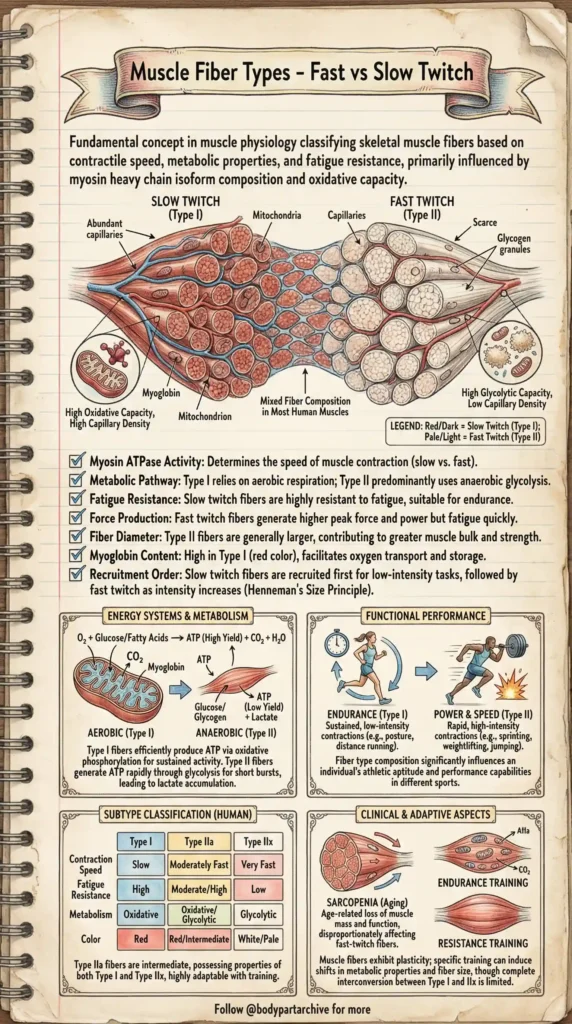
Often referred to as “red fibers,” Type I muscle fibers are the marathon runners of your musculoskeletal system.
Microscopic Anatomy: These fibers have a smaller diameter, allowing for a highly dense capillary network. They appear deeply red because they are packed with Myoglobin, a protein that heavily stores and transports oxygen.
Metabolism: Type I fibers rely almost entirely on Aerobic Respiration. Because they possess an abundance of mitochondria, they efficiently turn oxygen, glucose, and fatty acids into a massive, sustained yield of ATP (cellular energy).
Function: They contract slowly but boast incredible fatigue resistance. These are the fibers keeping your spine upright right now!
Type II: The Powerhouse (Fast Twitch)
When you need to jump, sprint, or lift a heavy weight, your body switches engines. Type II fibers are physically larger and built for pure, explosive power.
Microscopic Anatomy: These “white fibers” have significantly fewer capillaries, less myoglobin, and fewer mitochondria compared to their Type I counterparts. Instead, they are loaded with glycogen granules.
Metabolism: Type II fibers demand energy so rapidly that they bypass oxygen. They utilize Anaerobic Glycolysis to rapidly produce ATP. The byproduct of this fast, inefficient process is the accumulation of lactate (lactic acid), which leads to rapid fatigue.
Subtypes: Humans carry intermediate fibers (Type IIa) which possess oxidative and glycolytic properties, and extreme fast-twitch fibers (Type IIx) meant for very short, intense bursts.
The Brain’s Strategy: Henneman’s Size Principle
How does your body know which fibers to use? The nervous system operates on a strict rule known as Henneman’s Size Principle.
Motor units are recruited sequentially based on intensity. For low-intensity tasks (like lifting a glass of water), the brain exclusively recruits the smaller, fatigue-resistant Type I fibers. As the physical demand increases (like trying to lift a heavy barbell), the brain progressively recruits the larger, more powerful Type II fibers.
Clinical Implications: Aging and Plasticity
Muscle fiber composition is heavily dictated by genetics, but it carries vital clinical importance, especially as we age.
Sarcopenia is the age-related loss of muscle mass and function. Interestingly, this atrophy is not distributed evenly; it disproportionately shrinks and destroys fast-twitch (Type II) fibers. This explains why elderly individuals often retain their ability to walk long distances but lose the rapid reaction speed and power needed to catch themselves during a fall. Thankfully, muscle exhibits remarkable plasticity—targeted resistance training can induce hypertrophy in these fibers and effectively combat this age-related decline.
Conclusion
Your skeletal muscles are a brilliant combination of slow-burning endurance engines and high-octane powerhouses. By understanding the metabolic pathways and recruitment order of these fiber types, clinical professionals and athletes alike can tailor specific rehabilitation and training protocols to unlock the human body’s true physical potential.