
Introduction:
The Silhouette of Fear and Healing Few images from medical history are as instantly recognizable—and universally terrifying—as the Plague Doctor. Shrouded in a long, dark coat, wearing a wide-brimmed hat, and sporting an unmistakable bird-like beak mask with glass eyes, this figure looks more like a character from a gothic horror novel than a medical professional. However, in the 17th century, this imposing ensemble was the height of medical technology. Designed primarily by Charles de Lorme, the chief physician to Louis XIII, this outfit was one of humanity’s earliest systematic attempts to create Personal Protective Equipment (PPE) against deadly infectious diseases. But what exactly was the purpose of that bizarre beak, and did it actually protect the doctors who wore it?
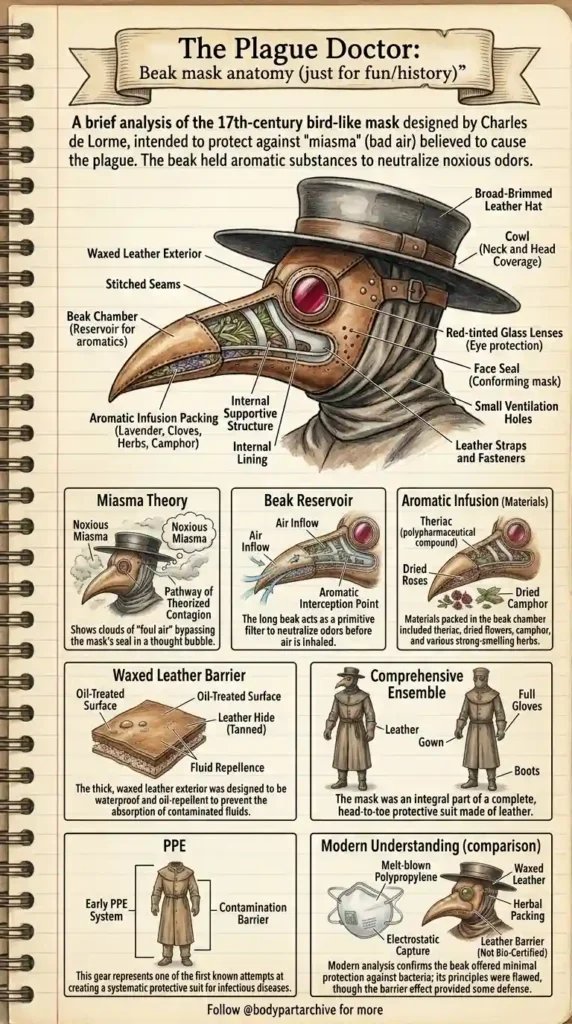
The Enemy: The “Miasma” Theory of Disease
To understand the anatomy of the Plague Doctor’s mask, we must first understand the medical science of the 1600s. Centuries before the discovery of microscopic bacteria and the germ theory of disease, the prevailing medical consensus was the “Miasma Theory.” Physicians believed that diseases like the bubonic plague were spread through “noxious air” or miasma—toxic, foul-smelling vapors emanating from decaying organic matter.
According to this theory, if you could avoid breathing in the bad smells, you could avoid catching the plague. Therefore, the primary goal of the plague doctor’s mask was not to filter out microscopic pathogens, but to physically intercept and neutralize foul odors before they could enter the physician’s lungs.
Anatomy of the Mask: Form Following Function
Every element of the Plague Doctor’s headgear was strictly functional, based on the miasma theory:
- The Beak Chamber (The Reservoir): The most prominent feature, the elongated beak, served a very specific purpose. It was not meant to make the doctor look like a bird; rather, it acted as an extended primitive filter. By forcing the inhaled air to travel down a long corridor, it gave the aromatics stuffed inside more time to “purify” the noxious miasma.
- Red-Tinted Glass Lenses: The eyes were protected by round glass lenses set into the leather. Some historical accounts suggest these were occasionally tinted red to ward off evil, but primarily, they served to protect the eyes from the foul air and infected fluids of patients.
- Waxed Leather Exterior: The mask and the cowl (covering the neck and head) were made of thick leather that was heavily treated with wax or oil. This created a solid face seal and an early form of waterproofing.
The Aromatic Infusion: What Was Inside the Beak?
The beak was packed tightly with a variety of strong-smelling substances—an aromatic infusion designed to overpower the scent of death and disease.
Common materials packed into the beak chamber included:
- Dried Roses and Carnations: For a strong, masking floral scent.
- Camphor and Cloves: Known for their sharp, pungent aromas.
- Mint and Lavender: To provide a continuous, overpowering herbal smell.
- Theriac: A complex, ancient polypharmaceutical compound containing dozens of ingredients (sometimes including honey, herbs, and even viper flesh), believed to be a universal panacea against poisons.
The Comprehensive Ensemble: An Early PPE System
The beak mask was only one part of a complete head-to-toe protective suit. The “comprehensive ensemble” included a long, heavy leather gown, full leather gloves, a broad-brimmed leather hat (which signaled their profession), and sturdy boots.
Much like the mask, the gown was made from tanned leather hide and treated with suet or wax to create fluid repellence. While they didn’t understand germs, the doctors observed that bodily fluids from patients were dangerous. The thick, waxed leather exterior was designed to be waterproof and oil-repellent to prevent the absorption of contaminated blood, pus, or respiratory droplets.
Modern Understanding: Did It Actually Work?
Looking at the 17th-century Plague Doctor through the lens of modern medicine reveals a fascinating paradox: they did the right things for the wrong reasons.
Modern analysis confirms that the beak, with its herbal packing, offered minimal to no respiratory protection against the actual bacterium that causes the plague (Yersinia pestis). Unlike a modern N95 mask made of melt-blown polypropylene that uses electrostatic capture to trap microscopic particles, the leather beak had small ventilation holes that allowed bacteria to easily pass through.
However, the suit was not entirely useless. The bubonic plague is primarily transmitted by the bites of infected rat fleas. The comprehensive, head-to-toe waxed leather suit, combined with thick gloves and boots, inadvertently acted as excellent armor against flea bites. Additionally, the fluid-repellent nature of the waxed leather provided a genuine contamination barrier against the bodily fluids of pneumonic plague patients. So, while the miasma theory was flawed, the barrier effect provided a crucial layer of defense.
Conclusion: A Legacy in Medical History
The Plague Doctor’s beak mask stands as a powerful testament to humanity’s enduring quest to fight disease, even in the dark before the dawn of modern microbiology. It represents a crucial stepping stone in the evolution of protective medical gear. Today, studying the anatomy of this 17th-century ensemble not only satisfies our morbid curiosity but also gives us a profound appreciation for the rigorous, evidence-based modern PPE that keeps our healthcare workers safe today.
(Discover more secrets of medical history and explore highly detailed, vintage anatomical prints at our digital archive. Visit our website to download your high-resolution Plague Doctor study guide today!)