Introduction: The Ultimate Biological Grid
Your nervous system is the most complex computing machine in the known universe. At its core, this vast communication network relies on a fundamental functional unit: the Neuron (or nerve cell).
Disclosure: As an Amazon Associate, Body Part Archive earns from qualifying purchases. This means if you click on a link and buy something, we may earn a small commission at no extra cost to you.
These highly specialized cells are engineered to transmit electrical and chemical signals throughout the body, allowing you to breathe, move, think, and feel. However, they don’t do it alone. They are heavily supported by an unsung crew of “janitor” and “mechanic” cells. Let’s dive into the microscopic archives to understand the exact anatomy of the brain’s building blocks.
Anatomy of a Multipolar Neuron
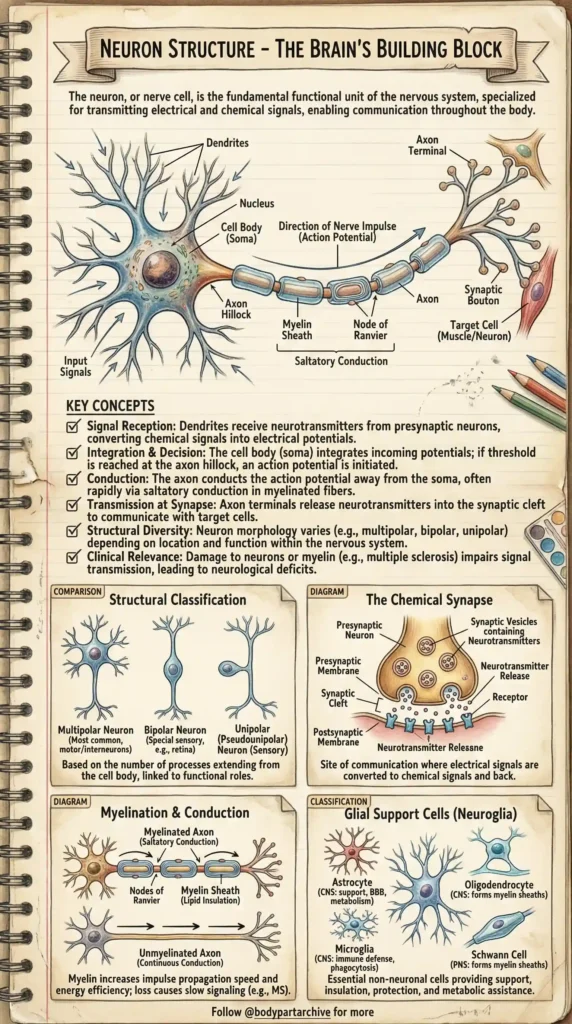
While neurons come in several shapes (structural diversity includes multipolar, bipolar, and unipolar), the classic multipolar motor neuron gives us the best look at how signals travel:
Dendrites: These branch-like structures act as the antennas. They receive incoming chemical signals (neurotransmitters) from other neurons and convert them into electrical potentials.
Cell Body (Soma): The integration center containing the nucleus. If the incoming signals are strong enough, it makes the “decision” to fire.
Axon Hillock: The exact trigger zone where an action potential (electrical impulse) is initiated.
The Axon: The long biological wire that conducts the action potential away from the cell body toward a target muscle or another neuron.
3D Brain Anatomy Model or Netter’s Neuroscience Coloring Book
(Product: 3D Brain Anatomy Model or Netter’s Neuroscience Coloring Book)
(Custom Text: “Archive Recommends: Visualize the Pathways. Neuroanatomy is incredibly three-dimensional. We highly recommend using a physical 3D Brain Model or a detailed Neuroscience Coloring Book to lock in these complex structures for your exams.”)
The Speed Hack: Myelin & Saltatory Conduction
If electrical signals simply traveled down the raw axon, your reflexes would be dangerously slow. To fix this, nature gave us the Myelin Sheath.
This fatty, insulating layer wraps around the axon, leaving tiny exposed gaps called the Nodes of Ranvier. Instead of traveling in a slow, continuous wave, the electrical impulse is forced to literally jump from node to node. This is called Saltatory Conduction, and it massively increases signal speed and energy efficiency.
Clinical Relevance (Multiple Sclerosis): Understanding myelin is crucial for pathology. In diseases like Multiple Sclerosis (MS), the body’s immune system mistakenly attacks and destroys this myelin insulation. Without it, the electrical signals slow down, scatter, or stop completely, leading to severe neurological deficits.
The Chemical Synapse: How Neurons “Talk”
Here is a fascinating truth: your neurons do not physically touch each other.
When the electrical action potential reaches the very end of the wire (the Axon Terminal), it hits a microscopic gap called the Synaptic Cleft. Because electricity cannot jump this gap, the presynaptic neuron must convert the signal. It releases chemical messengers called Neurotransmitters from tiny synaptic vesicles. These chemicals float across the gap and bind to specific receptors on the postsynaptic membrane of the target cell, essentially passing the message along.
The Unsung Heroes: Glial Support Cells (Neuroglia)
Neurons are the divas of the brain; they demand a lot of energy and are highly fragile. They rely entirely on non-neuronal support cells called Neuroglia to survive:
Astrocytes (CNS): Star-shaped cells that provide metabolic support, regulate the chemical environment, and help form the crucial blood-brain barrier.
Microglia (CNS): The dedicated immune defense team, performing phagocytosis to eat dead cells and bacteria.
Oligodendrocytes (CNS) & Schwann Cells (PNS): These are the vital cells that actually manufacture and wrap the myelin sheath around the axons to keep the signals firing fast!
Conclusion
Every memory you hold, every movement you make, and every sensation you feel is the result of millions of these microscopic structures firing in perfect synchronization. Mastering the anatomy of the neuron and the chemical synapse is the ultimate foundation for understanding how the human body truly operates.