Introduction: The Gatekeepers of the Throat

Every time you take a breath or swallow a bite of food, you are introducing millions of foreign microbes directly into your body. To survive this constant barrage, your immune system has stationed highly specialized guards at the main entrance: The Tonsils.
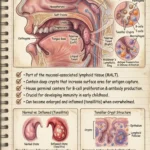
Far from being useless lumps of tissue that just cause sore throats, tonsils are a vital part of the Mucosal-Associated Lymphoid Tissue (MALT). They act as the body’s premier early-warning system, trapping pathogens and training your immune cells to fight them. Let’s open the histology archives to explore the complex anatomy of your throat’s first line of defense.
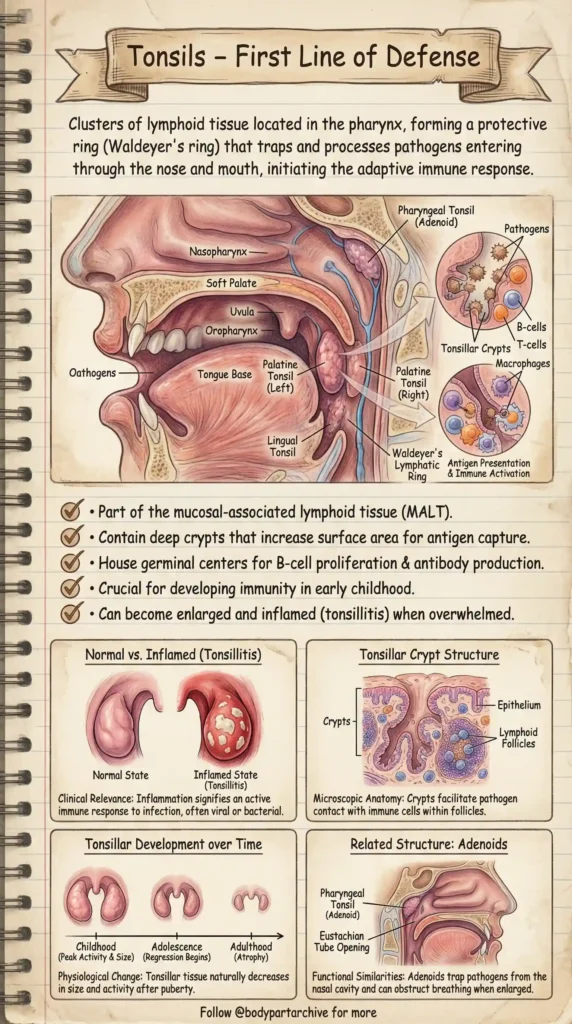
The Security Checkpoint: Waldeyer’s Ring
The tonsils are not just one single organ; they form a strategic, circular barrier around the opening of the pharynx known as Waldeyer’s Ring. This ring ensures that no matter whether a pathogen enters through the nose or the mouth, it must pass through lymphoid tissue.
The primary components include:
- Pharyngeal Tonsil (Adenoid): Located high up in the roof of the nasopharynx, directly behind the nasal cavity.
- Palatine Tonsils: The two prominent masses visible on either side of the back of the throat (the oropharynx). These are the ones most commonly removed during surgery.
- Lingual Tonsil: Situated at the very base of the tongue.
Microscopic Anatomy: The Tonsillar Crypts
How do the tonsils actually catch bacteria? The secret lies in their rugged microscopic surface.
Unlike a smooth organ, the surface epithelium of the tonsils deeply invaginates to form blind-ended pathways called Tonsillar Crypts. These crypts drastically increase the surface area. Food debris, bacteria, and viruses get funneled into these crevices, where they are trapped. Once captured, the pathogens are pushed through the epithelium into the underlying lymphoid follicles. Here, macrophages and B-cells process the antigens, kickstarting the production of targeted antibodies.
Clinical Pathology: Tonsillitis and Adenoids
Because their primary job is to physically capture pathogens, the tonsils are highly susceptible to becoming overwhelmed and infected.
Acute Tonsillitis: When battling a severe viral or bacterial infection (like Streptococcus), the palatine tonsils become massively engorged with blood and immune cells. The classic clinical sign includes painful swelling and the presence of white/yellow exudate (pus) spotting the surface.
Adenoid Hypertrophy: The pharyngeal tonsils (adenoids) present a different mechanical issue. Because of their location near the Eustachian tubes, when adenoids become enlarged, they can physically block the nasal airway. This is a leading cause of chronic mouth-breathing, snoring, and recurring middle ear infections in young children.
The incredible Shrinking Organ
One of the most unique physiological aspects of tonsils is their developmental timeline. They are absolutely crucial for developing immunity in early childhood, reaching their peak size and activity between the ages of 3 and 7.
However, as the immune system matures and becomes fully trained, the need for this large security checkpoint decreases. Following puberty, tonsillar tissue undergoes natural regression. By adulthood, the tonsils and adenoids have significantly atrophied (shrunk), which explains why tonsillectomies are predominantly pediatric surgeries.