Have you ever wondered why we have an appendix that seemingly does nothing but risk infection? Or why we have a tailbone but no tail? The answer lies deep within our evolutionary history.
The human body is a walking museum. Hidden within our anatomy are vestigial organs—anatomical structures that have lost most or all of their original ancestral function. Over millions of years of evolution, these structures have reduced in size or modified their purpose, yet they still persist in our population today.
Let’s dive into the fascinating comparative anatomy of the three most famous vestigial structures in the human body: the appendix, the tailbone, and our ear muscles.
1. The Appendix: Useless or Misunderstood? 🦠
For decades, the vermiform appendix was considered a completely useless organ—a ticking time bomb for appendicitis. However, comparative anatomy tells a different story.
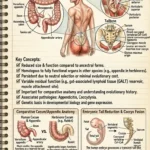
When we compare the human digestive tract to herbivores (like rabbits), the difference is striking. Herbivores possess a significantly larger cecum and appendix, which functions as the primary site for cellulose fermentation and absorption. Because human diets evolved to include cooked foods and less raw plant matter, our need for a massive fermentation chamber decreased.
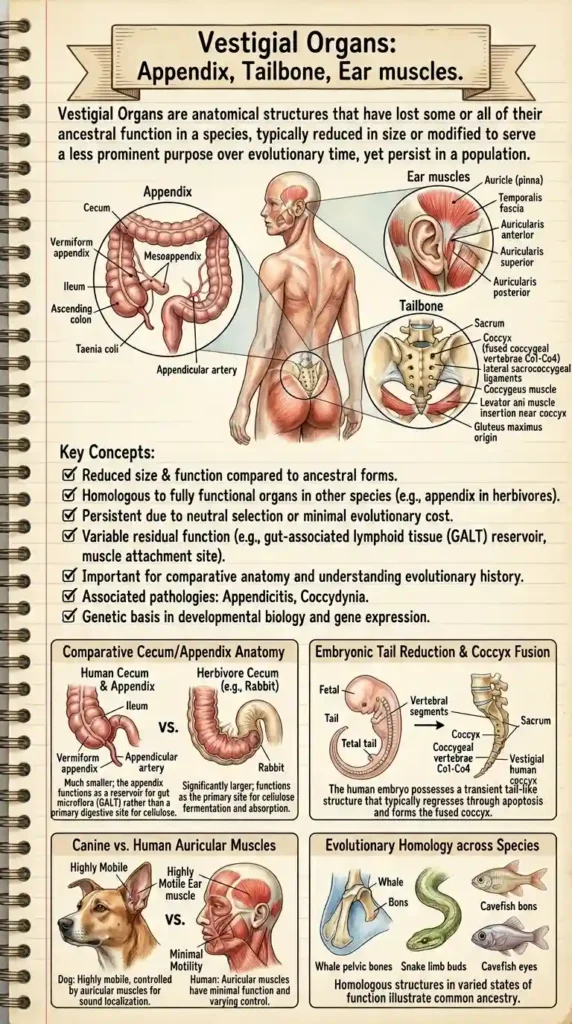
Does it have a residual function? Yes! Modern research suggests the human appendix acts as a reservoir for gut-associated lymphoid tissue (GALT). It serves as a “safe house” for beneficial gut microflora, helping our digestive system reboot after battling illnesses like diarrhea.
2. The Tailbone (Coccyx): Our Embryonic Past 🦴
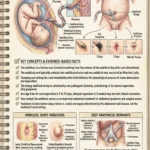
Look closely at a human embryo in its early fetal stages, and you will see a distinct, transient tail. As the embryo develops, this tail typically regresses through a programmed cell death process known as apoptosis.
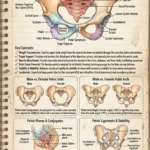
What remains is the coccyx—a fusion of the Co1 to Co4 vertebrae. While we no longer need a tail for balance or swinging from trees like our primate ancestors, the coccyx isn’t entirely without purpose today. It serves as a crucial insertion point for various muscles, ligaments, and tendons, including the gluteus maximus and the levator ani muscle. However, its vestigial nature makes it prone to specific pathologies, such as Coccydynia (tailbone pain).
3. Auricular (Ear) Muscles: The Canine Comparison 🐶👂
Have you ever seen a dog instantly perk up and rotate its ears toward a sound? Canines have highly mobile ears, controlled by strong auricular muscles, perfectly designed for precise sound localization.
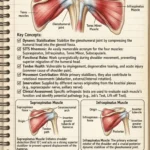
Humans actually possess the exact same muscles—the Auricularis anterior, superior, and posterior. However, in humans, these muscles have minimal motility. While a rare few can slightly wiggle their ears, these muscles have lost their primary ancestral function, serving as a perfect example of how evolution scales back features that no longer provide a strong survival advantage.
The Bigger Picture: Evolutionary Homology 🌍
Vestigial organs aren’t just limited to humans. They are vital clues for understanding common ancestry across all species. For instance:
- Whales have remnant pelvic bones from their land-walking ancestors.
- Snakes possess tiny limb buds.
- Cavefish, living in absolute darkness, still develop remnants of eyes.
These homologous structures, in their varied states of function, beautifully illustrate the shared evolutionary history of life on Earth.
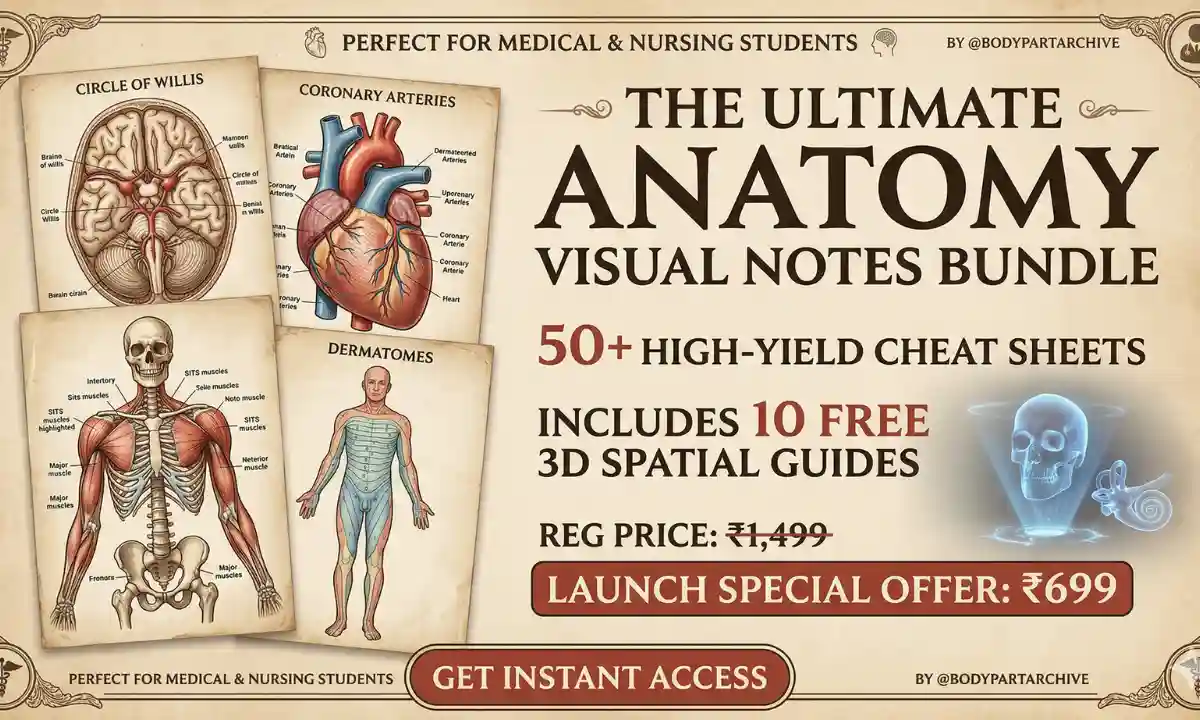
Tired of boring textbooks? 🛑 If you loved this visual breakdown, you need to see our complete master folder! Memorizing comparative anatomy and clinical pathology just got 100x easier.
Grab The Ultimate Anatomy Visual Notes Bundle by @bodypartarchive today. ✅ Get 50+ High-Yield Premium Cheat Sheets 🎁 Includes 10 FREE 3D Spatial Guides 👉 Click here to download your bundle at our Special Launch Price!