Disclosure: As an Amazon Associate, Body Part Archive earns from qualifying purchases. This means if you click on a link and buy something, we may earn a small commission at no extra cost to you.
Introduction: The Liquid Organ
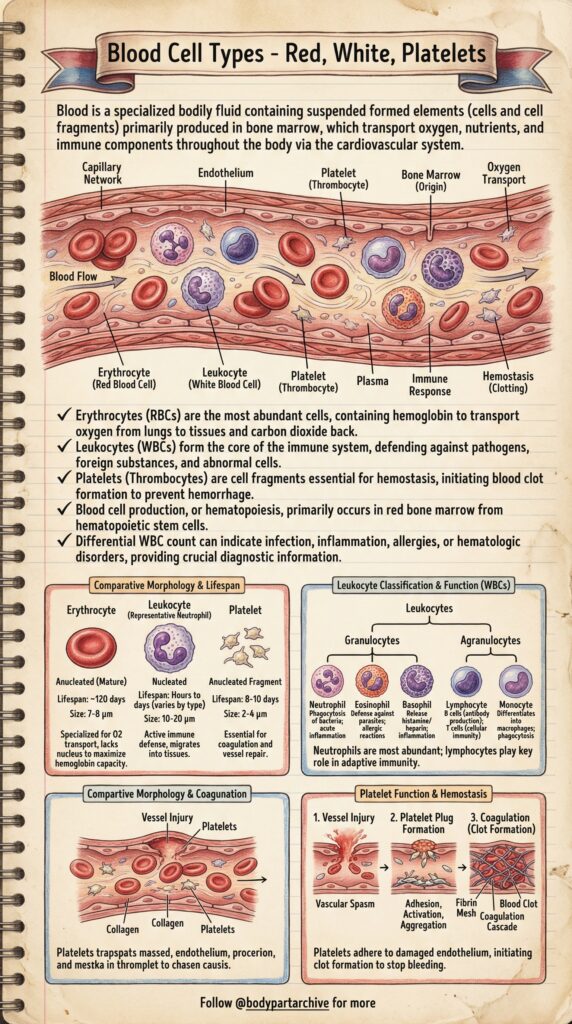
Blood is much more than just a bodily fluid; it is a highly specialized, continuously flowing organ. Driven by the cardiovascular system, it acts as a high-speed transit network, transporting life-saving oxygen, vital nutrients, and aggressive immune defenders to every tissue in your body.
Interestingly, the cardiovascular system doesn’t actually manufacture the blood it pumps. The process of creating these formed elements—known as hematopoiesis—primarily occurs deep inside the red bone marrow. Let’s open up the histology archives and look closely at the incredible cellular components suspended in your plasma.
Erythrocytes: The Dedicated Transporters
The most abundant cells rushing through your capillary networks are Red Blood Cells (Erythrocytes).
Looking at their morphology, these cells are uniquely engineered for one specific job: gas transport. During their development, they actually eject their nucleus. This anucleated (mature) state is a brilliant biological sacrifice, maximizing their internal volume to hold as much oxygen-binding hemoglobin as possible. Because they lack a nucleus to repair themselves, they have a grueling, short lifespan of roughly 120 days before they are recycled by the spleen.
USMLE Step 1 Medical Physiology Book or Netter’s Histology Flashcards
(Product: USMLE Step 1 Medical Physiology Book or Netter’s Histology Flashcards)
(Custom Text: “Archive Recommends: Crush Your Hematology Exam. Blood morphology is heavily tested on board exams. We highly recommend utilizing a premium set of histology flashcards to lock in these complex cellular classifications fast.”)
Leukocytes: The Frontline Defenders
While red blood cells keep you energized, White Blood Cells (Leukocytes) keep you alive. They form the core of the human immune system, defending the body against pathogens, parasites, and abnormal cells.
Clinically, leukocytes are classified into two major categories:
Granulocytes: These contain visible granules packed with chemical weapons.
Neutrophils: The most abundant WBCs, acting as the first responders to perform phagocytosis (eating bacteria) during acute inflammation.
Eosinophils: Specialized defense cells that target parasites and assist in allergic reactions.
Basophils: The rarest type, responsible for releasing histamine and heparin during inflammation.
Agranulocytes: These lack visible granules.
Lymphocytes: The masterminds of adaptive immunity, including B cells (antibody production) and T cells (cellular immunity).
Monocytes: Massive cells that differentiate into macrophages to consume dead cells and debris.
Clinical Note: Doctors frequently order a “Differential WBC Count.” Because different infections trigger different white blood cells, this count provides crucial diagnostic information regarding hematologic disorders or the specific type of pathogen attacking the body.
Platelets & Hemostasis: The Emergency Repair Crew
A severed blood vessel is a critical emergency, and your body relies on Platelets (Thrombocytes) to prevent a hemorrhage. Platelets aren’t technically full cells; they are tiny anucleated fragments that live for only 8 to 10 days.
When the endothelium (inner lining of a vessel) is injured, exposing the underlying collagen, it triggers Hemostasis:
Vascular Spasm: The vessel forcefully constricts to slow blood flow.
Platelet Plug Formation: Platelets adhere to the damaged wall, activate, and aggregate to temporarily plug the leak.
Coagulation Cascade: A complex chemical chain reaction converts proteins into a tough “Fibrin Mesh,” locking the platelets and red blood cells into a solid blood clot.
Conclusion
From the specialized, brainless erythrocytes to the complex, targeted warfare of the leukocytes, human blood is an absolute microscopic marvel. Understanding the morphology and function of these cells isn’t just trivia; it is the fundamental basis for diagnosing diseases, managing immune responses, and understanding how our bodies survive traumatic injuries every single day.